









Homepage / Services / Mechatronic System Design

Mechatronic System Design

We ensure that mechanics, electronics and software are integrated and work optimally together.

Selected customers

Some of the clients we've provided quality solutions for

Mechanical development meets mechatronic systems

At Rosenstand A/S, we develop complete solutions for industry, where mechanical engineering, electronics, and control technology go hand in hand. We design, build, and integrate equipment that combines robust mechanics with intelligent control – so our customers get reliable, flexible, and future-proof solutions.

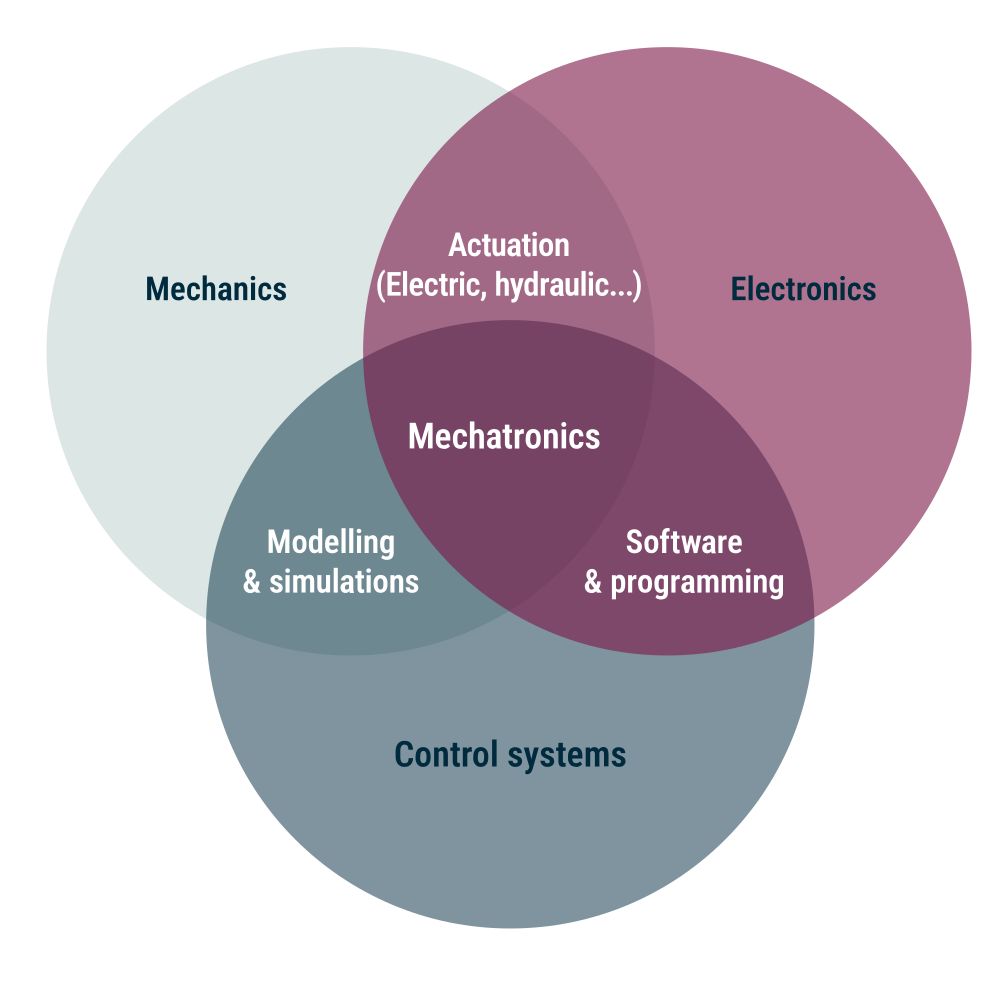
Our approach is built on the understanding that modern industrial production requires more than robust machinery. It demands mechatronic systems where sensors, actuators, and software optimise precision, speed, and energy efficiency.

By bringing together expertise in mechanical design, hydraulics, electrical engineering and programming under one roof, we can create solutions that:

  • Automating and streamlining production processes
  • Increases precision and quality in repeated operations
  • Makes the equipment easy to monitor, service and adapt to new tasks

From the initial design sketches to the final installation, we work closely with the client to ensure that the mechanics, electronics and controls work together perfectly.
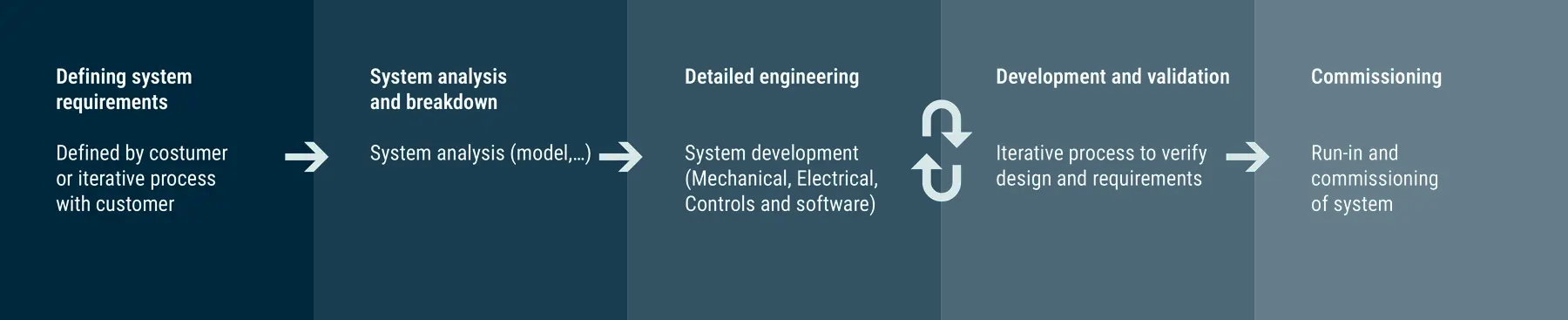
The process of mechatronic system design

The development process for mechatronic systems can be divided into 5 stages, which together cover the entire course from requirements specification to control of the finished system.
Click to enlarge

Feasibility study for complex systems

If we are talking about the development of more complex systems, we will conduct a feasibility study in close cooperation with the customer before the main task is started.

Feasibility study

Review and Understanding of System Functionalities

Review of the intended system functionalities, covering all relevant domains including the mechanical structure, actuation system, control system and safety mechanisms.

Functional decomposition

Defining functional and technical requirements for each subsystem.

Preliminary Risk Analysis

Top-level risk assessment to identify potential obstacles and cost drivers early in the process before selecting specific components.

Evaluation of Functional Reliability

The reliability of system functions and its impact on overall system performance and operational safety. Attention will be given to how subsystem interactions affect system-level robustness.

The impact of reliability on component selection and cost is a crucial consideration in product development. When selecting components, designers must balance the required level of reliability with the associated costs. **Impact on Component Selection:** * **Higher Reliability Components:** Components that are designed and manufactured to higher reliability standards often come with a higher price tag. This is due to more rigorous testing, tighter manufacturing tolerances, better materials, and more robust designs. Choosing these can reduce the likelihood of early failure, warranty claims, and customer dissatisfaction. * **Lower Reliability Components:** Conversely, components with lower reliability may be cheaper upfront. However, they pose a greater risk of failure during the product's lifespan. This can lead to increased costs in the long run through repairs, replacements, and potential damage to brand reputation. * **Application Demands:** The specific application dictates the required reliability. For critical systems (e.g., aerospace, medical devices, automotive safety systems), extremely high reliability is non-negotiable, even if it means significantly higher component costs. For less critical applications (e.g., some consumer electronics), a lower reliability threshold might be acceptable to manage costs. * **Environmental Factors:** Components must withstand specific operating environments (temperature, humidity, vibration, etc.). Components rated for harsher environments typically offer higher reliability but at a premium. * **Lifespan Expectations:** The expected lifespan of the product directly influences the reliability required from its components. A product designed for a short lifespan might use less reliable (and cheaper) components than one intended for decades of use. **Impact on Cost:** * **Upfront Component Cost:** As mentioned, high-reliability components are generally more expensive to purchase. * **Development and Testing Costs:** Ensuring and verifying reliability often involves extensive design validation, testing (e.g., HALT/HASS, life testing), and quality control processes, all of which add to development expenses. * **Manufacturing Costs:** Tighter process controls and higher quality materials in manufacturing for reliable components can increase per-unit production costs. * **Cost of Failure (During Warranty/Post-Warranty):** Failures can incur significant costs: * **Warranty Repairs/Replacements:** Direct costs of parts, labour, and shipping. * **Service and Support:** Costs associated with customer service, technical support, and managing returns. * **Product Recalls:** Extremely expensive, involving logistics, public relations, and potential legal liabilities. * **Lost Sales and Reputation Damage:** The intangible cost of customers losing faith in the product or brand. * **Total Cost of Ownership (TCO):** This encompasses both the initial purchase price and all the costs associated with using and maintaining the product over its lifecycle. A product built with reliable components might have a higher initial cost but a lower TCO due to fewer failures and lower maintenance requirements. * **Supply Chain Risk:** Using components with questionable reliability can introduce supply chain risks, leading to unexpected shortages or delays if components fail prematurely. **Balancing Reliability and Cost:** The key is to achieve an optimal balance. This often involves: * **Risk Assessment:** Identifying components critical to product function and safety and assessing the risks associated with their failure. * **Reliability Engineering:** Employing robust design practices and reliability prediction methods. * **Supplier Qualification:** Vetting suppliers to ensure their manufacturing processes and quality controls meet the required reliability standards. * **Cost-Benefit Analysis:** Evaluating the trade-offs between the cost of higher reliability and the potential costs of failure. * **Failure Mode and Effects Analysis (FMEA):** Systematically identifying potential failure modes and their impact. In conclusion, reliability is not just an engineering attribute; it's a critical factor that profoundly influences component selection decisions and the overall cost structure of a product. Making informed choices about reliability upfront can prevent much higher costs down the line.

A rough estimation of how reliability requirements influence component selection and associated costs, including redundancy and durability needs, within the mechatronic domain.

Preliminary Technical Specifications

Outlining component specifications based on functional needs, reliability, and integration.

Examples of solved tasks

  • Slewing system for wind turbine - evaluation of both hydraulic and electric systems
  • Hydraulic system for a 6-degree-of-freedom parallel manipulator
  • HPU design 50kW to 2MW
  • Hydraulic system for 700bar (HPU and cylinders)
  • Cooling system for 30MW test bench
  • Control system for large one-off test benches
  • Lubrication systems for gearbox, main bearing etc.
Contact us

Need help?

Contact Jens-Kristian Langkjær.

Write to us

Other business areas

See also our other business areas