There's no reason for academic snobbery; fundamentally, engineering is just a craft. While a carpenter uses theories of construction and tools to carry out a task, a mechanical engineer uses different theories and their computer. They are both craftsmen – in their own ways – and they both have to meet a series of quality requirements.
When assessing an engineer's quality, you can benefit from looking at the following parameters:
- Does the solution meet your needs?
- Is the collaboration good?
- Is the engineer working effectively?
- Is the quality of the final result high?
In this article, we will review the four parameters and show you how to use them when assessing the work of a mechanical engineer.
1. Does the solution meet your needs?
It goes without saying that the solution that is implemented should ideally meet your needs. Nevertheless, you shouldn't take the premise for granted, as there can be many reasons why an otherwise correct solution might not work in practice.
There are the completely obvious reasons; if, for example, you need a lifting yoke that can carry 20 tonnes, then it's no use if it can only be approved for 15.
However, it is rare for the technical specifications to create challenges. More often, the problem is that the solution you have in mind might not be the most appropriate.
That's why it's important that the mechanical engineer you've hired for the job asks questions about your needs and not just about the solution you already have in mind.
In order to develop a good solution, the engineer needs to know about the actual usage situation, storage, and transportation of the elements. The good solution therefore fulfils a wide range of needs in addition to the formal technical requirements for load-bearing capacity, surface treatment, etc.
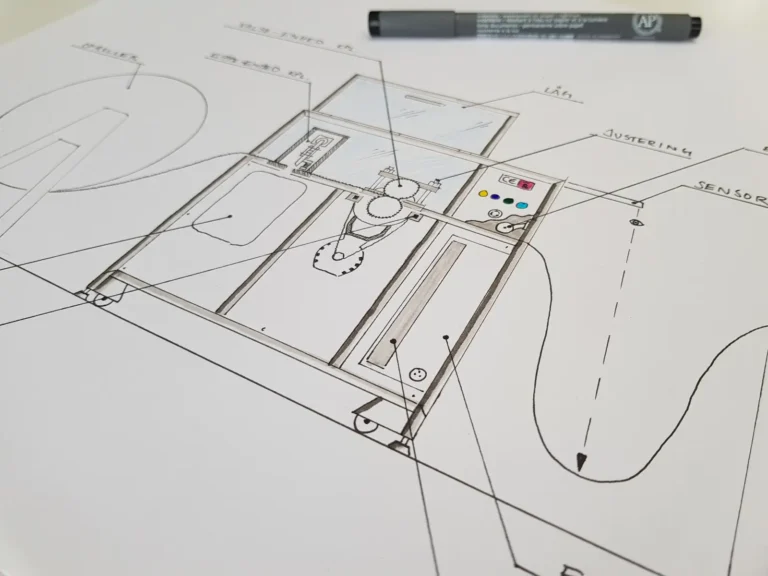
It can be a great advantage to sketch things out in the development phase, so you are sure you are not talking at cross-purposes. Both quick sketches on a whiteboard and more detailed drawings have their place, as long as they help to increase the shared understanding of how a solution can meet your needs.
When dealing with larger, more extensive projects, it often makes sense to begin the collaboration with a pilot project, where you test different solutions on a smaller scale, before the actual development project gets underway.
Often, many hours and money are saved by doing the preliminary work properly. The pre-project significantly minimises the number of adjustments to the final product.
Is the collaboration good?
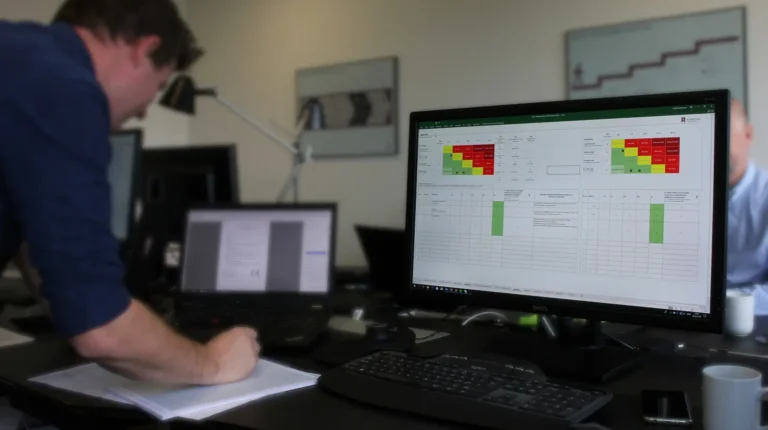
The collaboration between you and the mechanical engineer you have involved is essential for the project's success. Good and smooth collaboration requires good communication between you, so that both you and the engineer feel informed about the project's progress.
Communication works both ways:
The mechanical engineer must be well-informed about your requirements for the solution and must be confident that the decisions they make during development will also meet your expectations regarding quality, flexibility, and use of the solution.
In the same way, you must be informed about the project's ongoing status, and whether there are complications in the development process. If you are not informed, it is impossible for you to contribute input to the solution and to the progress of the project.
3. Is the engineer working effectively?
While it is relatively easy to assess whether your carpenter is working efficiently, it can be difficult to assess whether the engineer you have hired is doing the same.
To get an idea of the mechanical engineer's efficiency, you can ask some general questions:
Does your collaborator use templates to carry out their tasks? And have they automated the trivial processes involved in calculating, designing, and documenting projects?
In general, it's about whether the mechanical engineer works systematically. A systematic approach to development projects releases time to investigate the needs more thoroughly and to create a good and cost-effective solution.
High efficiency is also about asking for help.
Although not immediately considered an efficiency parameter, it is enormously important that the engineer you have hired has people around them whom they can ask for help if they get stuck on a problem.
Often, a challenge can be resolved simply by asking around to see if others have encountered something similar. If that's not enough, most stubborn problems can be fixed with a quick brainstorm at the whiteboard.
Although efficiency is of course primarily ensured through standardised processes and templates, there is also much to be gained from the mechanical engineer having easy access to input from skilled colleagues.
4. Is the quality of the final result high?
Just as you can easily assess the quality of a carpenter's work, because you can see with the naked eye if things are level, it is actually also relatively easy to assess the work of a mechanical engineer.
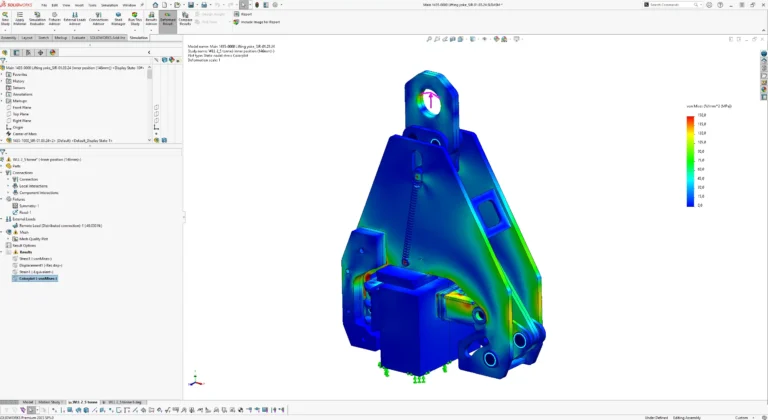
Here too, it's about how the final result looks; are the drawings and documentation understandable, and does it generally look well-finished?
Although they are relatively superficial landmarks, they still say something about how thorough the mechanical engineer has been. A thoroughness that will often permeate the entire work – including the calculations.
To deliver good quality, the engineer must also ensure that the final product can be manufactured cost-effectively. He or she must have thought through the manufacturing process and have knowledge of your value chain. What can you manufacture yourselves, and what can your suppliers help with?
If the press brake in your workshop can only take items up to three metres, there's no point in them being designed for four metres. Then, what cost nothing will suddenly become an expensive affair that needs to be sent out.
Therefore, quality is also about knowing what you can manage yourself, and what your suppliers can manage. This matters a lot for the final price of the product.
Ultimately, you can evaluate the work of a mechanical engineer in the same way that you would a standard craft business.
It's about understanding the need, cooperating well, working effectively and, of course, delivering quality that meets both legislation and your expectations, while keeping manufacturing costs down.