This can turn into an exceedingly expensive pleasure if there are errors in your working drawing. For example, it’s not very fortunate to have ordered 200 metal arms that are all a millimetre too short to be used for anything other than remelting.
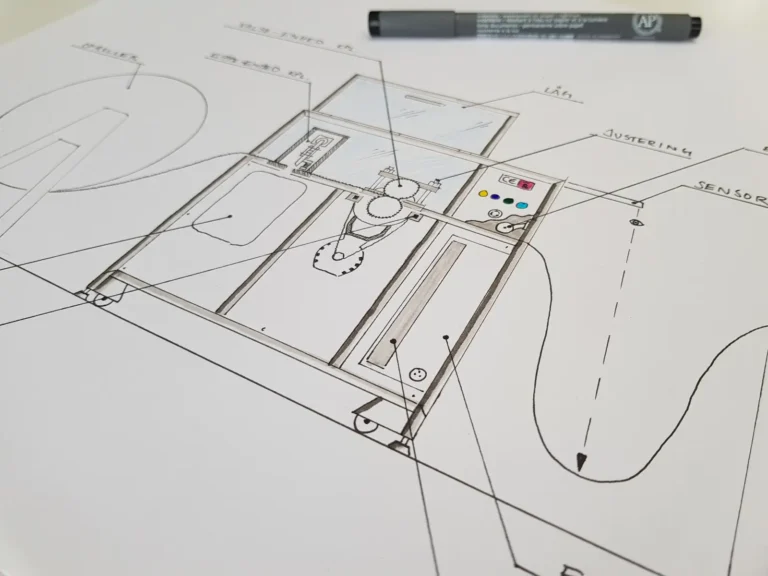
The working drawing is the link between the engineer and the workshop, between action and protocol. It is what workshop managers, welders, inspectors and material processers rely on when they start their work.
There are three things in particular that you need to pay attention to when preparing your working drawing: revision tables, setting tolerances, and review. By including these in the process, you simultaneously minimise the risk of the most common blunders.
1. Keep track of changes with a revision table
Even though you've made a good plan with your working drawing, it can easily become necessary to make small adjustments along the way.
It is important here that there is a detailed revision table on the working drawing. If not, the changes that individual parties carry out can be easily miscommunicated, and you risk the different parts no longer fitting together in the end.
2. Review your tolerance statement
You cannot manufacture or measure anything with complete precision; everything has tolerances. Therefore, setting tolerances is one of the most important things to be clear about. You need to figure out how precise the measurements of the different parts need to be, and how much variation you can tolerate.
It's a difficult task, as components often cost more than they need to if you use a general tolerance, or if you conversely play it safe and set tolerances that are too fine.
If you need a metal beam cut to a length of three metres, a blacksmith can easily measure off three metres with a tape measure and cut the beam at the line. This is quickly done and costs neither much money nor resources.
However, if what you need the beam for requires it to have very precise measurements – meaning tight tolerances – then other techniques must be used.
If you ask your blacksmith to perform the work according to ISO 2768 standards, he will have to measure again afterwards and correct it. Often, he will also need better tools and measuring instruments than he may have at hand. This requires more resources, and therefore the investment becomes more expensive.
Surface roughness is another factor you need to consider thoroughly.
The surface roughness of a material can, in fact, determine how an object should be manufactured; whether it needs to be ground, milled, or something else entirely. Each workshop has its limitations, and costs can therefore quickly increase if the object needs to be processed in several different locations just to meet tolerances.
Geometrical tolerances
Dimensional measurements are easy to make and therefore the cheapest to have done. Geometric tolerances, on the other hand, are difficult to control and therefore more expensive to get a handle on.
With geometric tolerances, you can describe the accuracy of shapes; how flat a surface should be, or how holes and angles should be positioned relative to each other.
GPS – or Geometric Product Specifications – covers the most precise measurements.
This is your only opportunity to create a complete and unambiguous tolerance statement, where you measure dimension tolerances (linear and angular), geometric tolerances (form, orientation, location, and run-out), surface characteristics (roughness, waviness, and more), as well as edge and corner properties.
The word GPS is often used in everyday conversation, but far from everyone understands it. It is far too complex a concept for the local blacksmith to grasp; he has neither the tools nor the skills. Therefore, this type of measurement is often expensive.
Only be precise when necessary
You should carefully consider which tolerances you specify on your working drawings.
If you're dealing with functional goals – that is, goals that ensure a machine's parts work together – greater accuracy is often more important. An accuracy that also requires subsequent inspection.
If you are making a box to transport your product in, exact measurements are less important as long as it is large enough to hold the contents.
So, it’s a good idea only to request exact measurements if necessary. There are significant savings to be made here.
3. Catch errors with a strong review process
As a final and third point, remember to carry out a review process so that you pick up any errors in your working drawings before you start production.
Some companies use inspection sheets where it is checked and stamped that all functional dimensions on the drawing are correct. The challenge here is that this happens at the end of the process, when the workpiece has already been produced. If there are faults with the workpiece, it often has to be scrapped, which is bad for both the environment and the wallet.
This is why a preliminary review is important.
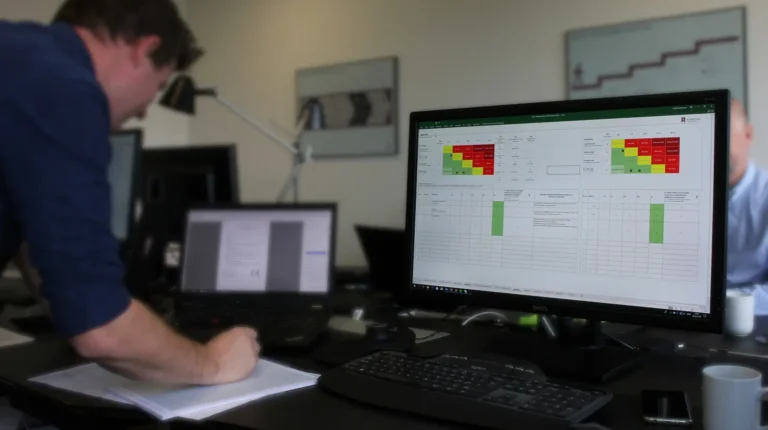
First, put the model itself and the drawing under the microscope. Is everything described correctly? Is the tolerance chain achievable? Are all descriptions present, are all dimensions included on the drawing, and is it clear which dimensions are functional and which are informational?
Next, you need to check if the workshop or the machines intended for the task can handle the tolerances and dimensions the workpiece is drawn to. For example, should we use a modern CNC milling machine, or is an angle grinder sufficient?
You should, at a minimum, review the drawings with a colleague, or alternatively, an external consultant with fresh eyes. This also applies if the company's most experienced senior engineer has produced them.